|
I have the excellent
book by Robert Bracken, "Spitfire - The Canadians" and acquired a
number of sheets from Watermark as a result of the artwork in the book. I
had been toying with doing the Mk XVIe conversion using the Falcon vacform
conversion set for a while. Recently I was involved with Ron of "Ron's
Resins" and his Seafire Mk 15 & 17 (I built the prototype Mk 17)
conversions for the old Occidental kit. In the resin pieces he provided
two shots of the resin low back spine. Then Hasegawa released their Mk IXe
and with the leftover spine I had all I needed (Canopy from the Falcon Spitfire
set).
Build:
the following items were used in the conversion:
-
Hasegawa Mk IXe
kit,
-
Eduard Seat
harnesses - Coloured
-
Resin spine from
Ron's Resins,
-
Canopy from
Falcon "Spitfire Special",
-
Mk XIVe from
memory
-
Watermark decals
for codes, serials and Dorothy II,
-
Extradecal for
national markings
-
Paint was
Aeromaster and Polyscale Acrylics.
Destruction
before construction
The first thing I did was to cut the spine off both fuselage halves. To do
this I cut down the fuselage break panel line in front of the tail until I had
reached the panel line running fore/aft. This cut is only about 2-3mm.
I then placed a piece of plastic label tape (Dymo) from the rear canopy cut-out
to the the first cut. It follows the for/aft panel line. I scored
this with a "P" cutter several times then gently flexed it until the
plastic broke away.
|
Click on
images below to see larger images
|
|

|

|

|
The cockpit was
built with the addition of the canopy opening mechanism on the right hand side
of the cockpit. Also I cut out the cockpit access hatch and substituted a
door from the spares box. A downside of the kit is that the fuselage is
quite thick for the scale so it is a trade off to view the excellent cockpit
detail. It was painted interior green with the famous red-brown bakelite for the
seat. Details were picked out in different colours and a wash was applied to add
depth. The cockpit that comes with the kit looks pretty busy and I think
it is a reasonable representation. I used the kit supplied
"Windscreen" but the rear bubble canopy was taken from the Falcon
Spitfire Special set, the canopy was for a Spitfire Mk.XIVe.
I added seat harnesses from the Eduard British "coloured" late harness
set, (these are wonderful things and make it easy to add realistic
fittings). The fuselage halves were joined and the glue allowed to set
overnight. I was careful as it is weakened without the spine. I then
dry fitted the spine and found it about 2mm long (no suprises there) and it was
sanded until it fit. The cockpit was glued into place from the bottom and the
spine was secured with super glue. There was almost no filling required
and what was, was done with Mr Surfacer. All panel lines and the radio
hatch were rescribed at this point. The windscreen was fixed in place and masked
and the door and Bubble were "tacked" in place with white glue to
allow them to be painted along with the main airframe. I do this because
it avoids the "after thought" look that some have if they are added
later and not washed or weathered along with the rest of the airframe.
I read on one of the discussion groups how somebody had shortened the kits
spinner by deepening the prop cutouts and sanding the same amount off the rear
of the spinner before attaching it to the back plate. I did this and
removed about 1.5 mm and like the result. (Thanks Drewe)
The remainder of the kit was then built as per instructions and without need for
filler.
Paint & Decals
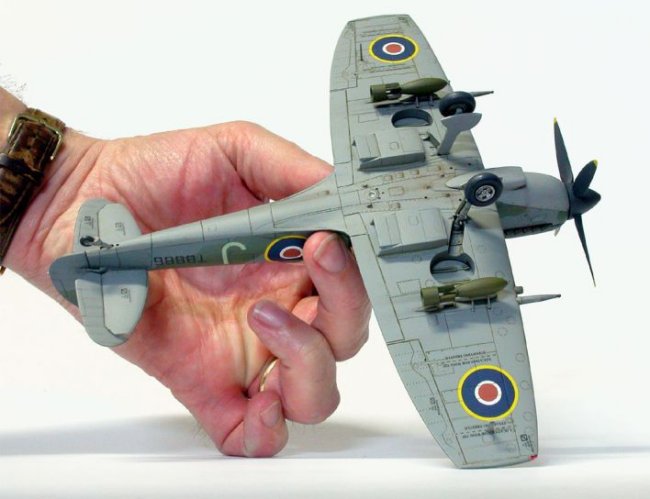
The kit was given an overall spray of medium sea grey and checked for blemishes.
I spayed SNJ along the wing roots for later "chipping" I then masked
and sprayed the ocean grey. I masked out the ocean grey and sprayed the
dark green. This only took an afternoon as I use a hairdryer to speed the
drying of the paints. The model was then polished with "smokers"
toothpaste and washed to ready it for decaling. The toothpaste gives the
model a nice sheen and negates the gloss clear step so many use. It also removes
any things that may adhere during the process. Just be careful not to be
too vigorous or you can rub through the paint. I then chipped various areas by
gently scratching the kit with a toothpick.
The Watermark decals were a bit disappointing in that they were thick and I
could not get Micro Sol/Set to make them to snuggle down. I substituted
Extradecal for national markings. The stencils came from the kit sheet.
After the decals had dried I washed the model to remove setting solutions and
then applied washes to the panel lines. I use a student acrylic range of
tube paints called "Chromacryl" that are available from newsagents
quite cheaply here in Australia. I add some liquid dishwashing detergent
to the wash so that it cleans off the "unsealed" polished paint.
I use either black or dark grey on the upper surfaces and dark brown on the
underneath. When the wash was dry I cleaned the model with small pieces of
damp sponge wiping back in the direction of the airflow.
The model was sprayed with Polyscale matt acrylic varnish and dried. I
then applied chalk to simulate exhaust staining, fuel spills, oil leaks and dirt
left behind by shoes. The pictures I have of this aircraft show her to be
fairly new and "looked after" so this was the look I attempted to
capture in the weathering. I sprayed another light coat of mat varnish to
seal the pastels.
The canopy was unmasked and the door and bubble glued into their final
positions, The Exhausts, undercarriage, bombs and aerials were also attached at
this point. Prop pushed home and she was finished.
|
Click on
images below to see larger images
|
|

|

|
There has been a lot written
about the Hasegawa Spitfire that I'm not going to comment on only to say that it
looks like a spitfire to me. This kit goes together without problems and I
will definitely build more. The conversion is a simple one and took me two
weekends to complete. To my mind the Mk XVI is the prettiest spitfire of
them all especially those with the full span wings.
Thanks to Ron for the resin bit and to Jamie Davies for the excellent
photographs. Also to people like Bob Swaddling, Bruce Archer, Graham Boak and
Drewe Manton and others for freely sharing their knowledge on the discussion
board, as I have picked up a wealth of knowledge on this aircraft from them.
Tim
|
Click on
images below to see larger images
|
|

|

|
|
|