|
When you think of significant
Naval aircraft during the Vietnam War, several easily come to mind; F-4, A-7,
A-6, A-1, and the list goes on. But,
there is only one aircraft that has the reputation as a “Gun Fighter” and
has a nick name of “Mig Master”. The reputation and the title can only
belong to the Chance Vought F-8 Crusader.
The F-8’s served in the
Vietnam war from day one until 1972.
It served in both US Navy and US Marines.
It earned the nick name “MIG Master” with 18 confirmed Mig kills to
its tally. The nick name “Gune Fighter”
The article and the colorful
pictures of the F-8 fighthers in the Osprey F-8 Crusader Units book really gave
me the inspriation to do a model of the Crusader.
When it comes to an F-8 in 48th scale Monogram is the only
game in town. That makes it a
challenge because this kit is a vintage kit and is out of production.
However, my luck has it that Uncle Bills Hobby Shop just happens to have
one of these vintage kit hidden in the cellar and I was able to purchase one.
After buying the fantastic decals from AeroMaster, and borrowing Mike
Grant’s copy of the Detail & Scale book, off I go into another S&M
session with a Monogram kit. Thanks
Mike.
The Monogram kit is an F-8E. It can be made into a D or H version quite easily.
The model I’m building is a J model flown from the USS Hancock in 1972
by the CO of VF-24 “Checkertails”.
The resin tail fin tip conversion for a J version is provided in the
AeroMaster decal sheet No. 48-403, “Colorful Crusaders I”.
This is a bonus as this saved me many hours from making the conversion
from scratch.
Construction
The kit is a typical Monogram
kit with raised panel lines. I
rescribed all panel lines. Due
to the small size and simple shape of the F-8, rescribing the panel lines is a
breeze. Anyone wanting to learn how
to scribe panel lines, this is the kit to practice on.
I dry fit every major parts
together and found the fit to be good.
If the wing is glued in the down position, there would be some gaps to be
filled but, this would not matter if the model is to be shown with the wing in
the raised position. Each
stabilizer came in one piece and are simply pressed fitted into the hole
provided in the fuselage. The
highly visible air intake at the nose has a really bad seam when the fueslage
halves were joined together. I
used a home made putty spatula and spread a lot of putty inside the intake to
fill up the seam. After more putty and sanding, I finish off the job
using a thin spread of cyanoacrylate to coat the finished putty job.
After the Cyano had a chance to dry, I immediately wet sand this smooth
to get a seamless sucker.
The rest of the construction is
very simple thus, do not require a lengthy discussion.
For brevity, I will only discuss the major modification work involved
with my model.
Cockpit
I scraped away the kit raised
details for the side console panels and rebuilt them using styrene sheet
built-up. I made the dial buttons using thin slices of stretched
spruce. The kit cockpit sides are
devoid of details with the exception of the raised fuselage framing.
I followed the pictures of the cockpit sides shown in Detail & Scale
and made up the details using styrene.
The rear deck of the cockpit,
behind the seat, have some raised ribbings used for pressure sealing the canopy
to the fueslage. I added these
ribbings using custom cut strips of styrene and bending them into shape.
The canopy spring actuating rods were added using similar shaped
rods from my scrap box.
As of May 2001, I have read
that Black Box will come out soon with a resin cockpit set for the Monogram F-8. I guess I’m a few months too late (or too soon in
this case) to make use of it.
Modify Landing Gears
The major flaw with this
Monogram kit is that the main landing gear sits too low, causing the ventral
fins and the belly main gear doors to drag the ground.
To correct this flaw, I followed the instructions provided in the article
in the July 1992 Fine Scale Modeler and modify the landing gear length. The
essence is described here.
The nose gear is length by
cutting off the strut just below the gear bracing.
An extension piece that is around 1/8” long was glued between the two
cut off pieces to lengthen the nose gear.
The main gear takes a little
more work. I first photocopy the
kit’s original gear strut on a photocopier to get a template to work with.
I then draw the new position of the main gear on this photocopy template.
Then, I cut off the top struts near the wheel mount as shown.
To get the struts down to the new position, I carefully bend both top and
bottom struts until they are at the desired positions.
This will result in the wheel mount being angled downward and not
parallel with the horizontal. To
fix this, I applied a little bit of heat to the bottom strut near the
wheel mount using a match located far from the part so as not to melt it.
With a bit of heat, the part became pliable and I was able to bend the
wheel mount angled up a little to compensate and thus making the wheel mount
close to being parallel with the horizontal.
|
|
With the gear in what I think
is the correct position, I dry fit the wheels on and tape the main strut part 15
into fuselage. The nose gear
is also dry fit into position at this time, with the nose wheel inserted.
I made some measurements of the ground clearance to the underside of the
fuselage to confirm if I got the gear extensions correct.
I compare the actual “scaled” measurements against the measurements
given in the F-8 Detail & Scale book.
If it is not correct, I just keep bending the lower main gear strut until
I got close. Once I’m satisfied
that I got it about right, I fit in a piece of extension piece made from
stretched sprue. For me this
is a trial and error exercise and I’m not too concern about getting it exactly
correct. As long as it looks
right, I’m happy.
Alternatively, if you don’t
want to go through this whole exercise and you got money to burn, you can
purchase the metal correction landing gears from Cobra.
F-8E to F-8J Conversion
The Monogram F-8 kit is an F-8E
or H version. The F-8Js were
remanufactured F-8Es and therefore the appearance between the two versions is
very similar except in a few areas. To
convert it to an F-8J, I made the following modifications.
| Click
on picture for larger picture |
 |
1. Replace the kit seat to upgrade it to a Martin Baker Mk.F7 seat.
I used a spare True Detail F-4 resin seat.
I followed the pictures shown on the Ejection Seat web site at www.bestweb.net/~kcoyne/mkf7seat.htm
to modify the F-4 resin seat. I
shaved and sanded flat the head cushion sides to resemble the metal cushion
holder that is found in late Crusader seats and painted that area black.
I made the fabric pouch (seat safety pins pouch) using leftover resin
bits and painted it white and glued it to the left side of the seat. The M.B. Mk. F7 seats has a raised seat pan sides and
had an initiator handle mounted on the right side of the seat pan side.
I made these from styrene sheets.
After the seat is painted, it looks just right.
Very
recently, I saw a M.B. resin seat from Cutting Edge that is for the pre-70s
Phantoms and it looks just perfect as the proper replacement seat for an F-8J. All that is needed is to add the safety pin pouch.
2.
Replace the tail fin rear warning radar bulge on the E version with the
long ECM bulges. This was
fairly easily accomplished using the resin tip provided with the AeroMaster F-8
decal.
3.
Replace the one piece wing leading edge flap with a double droop leading
edge flap. The double-droop wing
leading edges plus the added boundary layer control system gave the J versions a
reduction in landing speed from 113 knots to below 90 knots.
This innovation came about as a result of the development for the export
version of the Crusader to the French Navy, the F-8E(FN).
This detail is relevant to my model because the wing is posed in the
raised position, and when the wing is in this position all the flaps are
naturally dropped.
I managed to find a forgotten box of KMC resin flaps for the F-8 in the local
hobby shop. I was happy to
use it just so I can speed up the building process.
The only problem is, the leading edge flaps were the one piece
flaps typical of all non-J version of the Crusaders.
To correct this problem, I cut each leading edge flaps, length wise, in
halves. I sand the cut seams to attain a camber so that I get a
double drooping flap. Once I got
the pieces mated to the proper angle, I added a custom cut stripe of styrene to
fit in between the top gap in the leading edge flaps to simulate the flap
extension. I had to guess at what
the proper droop angles should be for the front flaps by looking at the sketch
shown in the Osprey book on the F-8 Crusader Units.
4.
Replace the stabilizers and make it to the correct dimensions as shown in
Detail & Scale: The Js had a
slightly larger horizontal stabilizers, according to the dimensions shown in
Detail & Scale. I decided
the slight difference does not warrant a rebuilt of the kit parts.
As long as it looks about right for a model, that’s good enough for me.
Raise the Wing
The Crusader is the only Naval
aircraft I know of that has the unique raised wing feature.
This feature allows a higher angle of attack during take-off and landing.
The raise wing feature is only available in two position; either raised
up or down. It is amazing that the
raising of the wing is done by a single actuating rod near the front of the
wing. The force in the rod
must be tremendous during the closing of the wing when the aircraft is in
flight!
The raised wing is a feature
that I must represent on my F-8 model. To model the wing raised, all the flaps
must be dropped and the fuselage area under the wing must be completed.
Although the Monogram kit does not provide all the parts and details
necessary to do this, any modeler with a some basic skills can scratch built the
details to raised the wing. I
followed the instruction given in the July 1992 Fine Scale Modeler article by
Donn Wells and the detail photos in Detail & Scale to scratch build the
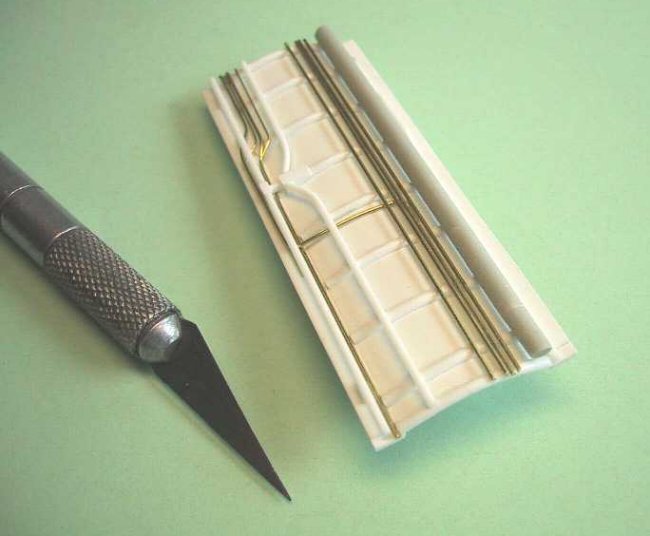
underwing fuselage bay.
|
The underwing fuselage bay is scratch built using 0.03” styrene sheets cut and
formed to the dimensions shown.
|
|
| As I do not have the exact
dimension for all the parts in this bay, I had to use creative license to
complete the details. To form
the arch in the bay, I placed the styrene sheet in a pot of boiling water to
soften the plastic and then quickly bend the center part over a cylindrical
object until the desired shape is formed. I
used 0.060” half round styrene strips to simulate the stiffeners.
Various diameters of brass wires were used to simulate the pipes that run
from one end of the bay to the other end.
The remaining details were all made from various styrene shapes.
I made two bulk heads and glued them to the model to seal off the bay.
According to the photos in Detail & Scale and in FSM, the entire bay
was painted white and was left clean.
I used two different diameter of polished aluminum tubing to make the
actuating rod; the rods were left unpainted for the natural metal look. The universal joint detail on top of the rod was
scratch built out of sheet styrene and was painted white. |
| Click
on picture for larger picture |
 |
|
The wing should be raised such
that the underside of the wing is in line with the top of the fuselage.
The wing is not glued to the plane: It is held tightly in place by
sandwiching the fuselage between the trailing edge flaps.
Fold the Wing
I figured if I already raised
the wing, why not fold it too. This
is the easy part. Monogram
kindly provided the outboard wing panels as separate pieces so you can model it
folded. However, wing fold is devoid of any fold mechanical
details. I added the wing
locking mechanisms cut from styrene strips and bar.
Step into the Cockpit
If the canopy is open,
there’s got to be a way to get into it.
To do so, there are three boarding steps that have
to be added to the port fuselage side by the cockpit.
This step should be performed before the fuselage is assembled.
|
Click on picture for
larger picture |
 |
 |
I decided to add these details
in after the fuselage was already assembled.
I cut out the 3 rectangular (oversized) openings on the port fuselage for
the boarding steps. After I cut out
the openings, I made 3 boxes from 0.01” thick styrene sheet to fit inside
these cut outs to close the openings.
Boarding steps were made from 0.01” sheet build-up.
The bottom (lowest) step is a slide out rung and that is modeled using
brass wire and styrene strip.
Detail that Large Main Gear Bay
The main landing gear bay in an F-8 is so cavernous that it
begs for more details. Monogram did
an excellent job of providing enough details for the attachment area surrounding
the main gear, however, the front of the gear bay is devoid of detail.
This is the area to concentrate the work on.
I followed the pictures in Detail and Scale and scratch
built the boxes and stuff at the front of the landing gear bay.
Additional piping were added using brass wires.
The main fuel receptacle cover plate in the port gear bay was added and
painted red. Additional “stuff” in the bay were added using
similar looking model rail road parts.
Additional Add Ons
True Detail photo edge mirrors were added to the canopy
frame to complete the canopy. The
AIM-9Bs came from the Hasegawa weapons set.
F-8 canopy uses a spring loaded strut to pop the canopy
open. To close it the pilot had to
pull on a strap, which is mounted to the canopy, to get it to the close
position. I model this strap
using a folded aluminum paper cigarette wrapper.
Decal
There’s not much more I need to say, the decals are
AeroMaster decals. They went
on great with the help of Gunze Mr. Mark Softer and Microscale Micro Sol.
Painting
Like the A-7s the F-8s had a portion of the fuselage next
to the stabilizers left unpainted (bare metal).
This area was subject to occasional abrasive contact from the stabilizer
and if this was painted it would probably just rub off.
To simulate this bare metal area, I would paint it with Model Master’s
buffable aluminum color. To prepare the area where aluminum paint would go, I
made a painting mask from tape and cover the area before any painting so that
the metal color would go on unpainted plastic.
The model was painted with Gunze acrylic.
The standard two tone NAVY gull grey over white was applied using Gunze
325 (FS26440) and gloss white.
A coat of Future was applied over the model before and after application
of decals. I accentuated the panel lines with enamel dark
grey and artist Raw Sienna oil paint.
The coat of Future protected the acrylic paint from the enamel/oil panel
wash. The top grey surfaces was
coated with Gunze Flat to even out the tone and a semi-gloss was sprayed on the
bottom white surfaces to take the shine off of the gloss white. Some dirty area of the panel lines were sprayed with a
mix of ultra-thined wash of dark grey.
The natural metal area by the stabilizer and the rear
exhaust panels were covered by a custom cut mask just before painting.
After completing the painting, the masks were removed and Model Master
buffable aluminum plate color was sprayed on to the bare plastic areas and
buffed to a shine. The heated
area of the aluminum plate by the afterburner can was painted using a mix of
buffable aluminum plate and titanium.
Recommendation
Without a doubt, this is the MOST GRATIFING and MOST
SATIFYING Monogram kit I have ever built.
I will do another one if I can find another box, and this time I’ll use
the Black Box cockpit with it.
This project only took me 3 months (on and off) to
complete. Better yet, I did
not have to wait for Tamiya to come out with a 1/48 scale F-8 kit.
Everybody should try a hand with this kit and raise the wing.
So what are you waiting for? Go
find one and start enjoying this fine Monogram kit.
And one more thing, shed a tear for the last gun fighter.
Reference Material:
1. “F-8
Crusader”, in Detail & Scale,
Bert Kinzey
2. “F-8 Crusader in Action”, Squadron/Signal
Publications, Jim Sullivan
3. “F-8 Crusader Units of the Vietnam War”, Osprey Combat Aircraft –
7, Peter Mersky
4. Wings of Fame Volumn 5, AIRtime Publishing Inc.
5. FineScale Modeler, Vol. 10 No.
5 July 1992, Donn Wells
Wayne
(click on
the image below to load the full size photo)
(use your
back button to return to this page after viewing full size photo)
|